Why 2025 changed the EU nail gel formula conversation
If you are sourcing gel polish for the European market, two ingredient names now decide whether a formula can be placed on the market at all: HEMA (2-hydroxyethyl methacrylate) and TPO (diphenyl(2,4,6-trimethylbenzoyl)phosphine oxide). Both were normal parts of professional nail systems for over a decade. Both are now restricted or prohibited, and the restrictions sit in Annex II and Annex III of Regulation (EC) No 1223/2009, the EU Cosmetics Regulation.
The practical consequence for a brand owner is simple: a supplier who cannot document the HEMA and TPO status of a specific formula, for a specific batch, cannot support your CPSR, and without a CPSR you cannot notify the product on CPNP. This article explains what changed, what it means for cure performance, and how to write the requirement into a purchase order so it is testable instead of aspirational.
HEMA: restricted, not banned
HEMA was restricted by Commission Regulation (EU) 2020/1682, which added entry 13 to Annex III. The restriction is often summarised incorrectly in supplier marketing. The accurate version is:
- HEMA may only be used in nail products intended for professional use. Consumer-facing retail gel polish is outside that scope.
- Products containing it must carry the warning “For professional use only” and the statement “Can cause an allergic reaction”.
- The restriction applies from 3 June 2021. Products placed on the EU market after that date must comply.
- The same regulation restricts Di-HEMA trimethylhexyl dicarbamate (Di-HEMA TMHDC), which is why “HEMA-free” and “Di-HEMA-free” are two different claims.
This is why a serious supplier separates two product lines rather than relabelling one. A professional-only line can legally contain HEMA. A line sold to consumers, or sold into markets where the professional-use channel does not exist, needs a genuinely different formula. “HEMA-free” printed on a label while the formulation still contains Di-HEMA is a documentation failure that surfaces at the CPSR stage, not at customs.
TPO: prohibited in cosmetic products from 1 September 2025
TPO moved from restricted to prohibited. Commission Regulation (EU) 2025/877 of 12 May 2025 amended Annex II to Regulation (EC) No 1223/2009 as part of the seventh omnibus update, adding 21 substances newly classified as CMR (carcinogenic, mutagenic or toxic for reproduction). TPO and DMTA (dimethyltolylamine) were the two entries that hit UV-cured nail systems hardest. The prohibition applies from 1 September 2025, which means products containing TPO can no longer be placed on the EU market.
Two details matter commercially:
- It is a placing-on-market rule, not a shelf-clearing rule. Product already placed on the market before the cut-off can generally continue to be made available, but no new units may be placed. Your importer, not the factory, carries that distinction in an audit.
- Labelling is not a substitute for reformulation. There is no warning label that makes a prohibited substance compliant.
What TPO-free actually costs you in performance
TPO is a highly efficient photoinitiator for pigmented systems, which is exactly why it was everywhere in gel polish. Removing it is an engineering problem, not a marketing line. The three trade-offs we work through with brand owners are:
| Trade-off | What typically happens on a TPO-free system | How it is mitigated |
|---|---|---|
| Cure speed in deep or opaque shades | Slower through-cure in white, nude and heavily pigmented gels | Photoinitiator blends (BAPO/TPO-L alternatives), adjusted photoinitiator concentration, longer recommended cure time |
| Yellowing and shade drift | Some substitute systems shift slightly after cure or over time | Stabiliser packages, light-stability testing, batch colour verification against a retained standard |
| Adhesion and flexibility | Changing the initiator can change the polymer network slightly | Re-tuning oligomer ratios; re-running adhesion and soak-off tests rather than assuming equivalence |
A supplier who says “TPO-free, same performance, no change to cure time” without new test data is describing a hope. Ask for the test report, not the adjective.
How to specify this in a purchase order
Vague ESG-style language in a PO produces vague answers. These seven clauses are specific enough to be verified, and short enough to survive a legal review:
- Substance declaration per batch. Signed declaration listing HEMA, Di-HEMA TMHDC, TPO and DMTA status, with CAS numbers, per batch number.
- Full INCI list matching the declaration, with no “may contain” ambiguity for restricted substances.
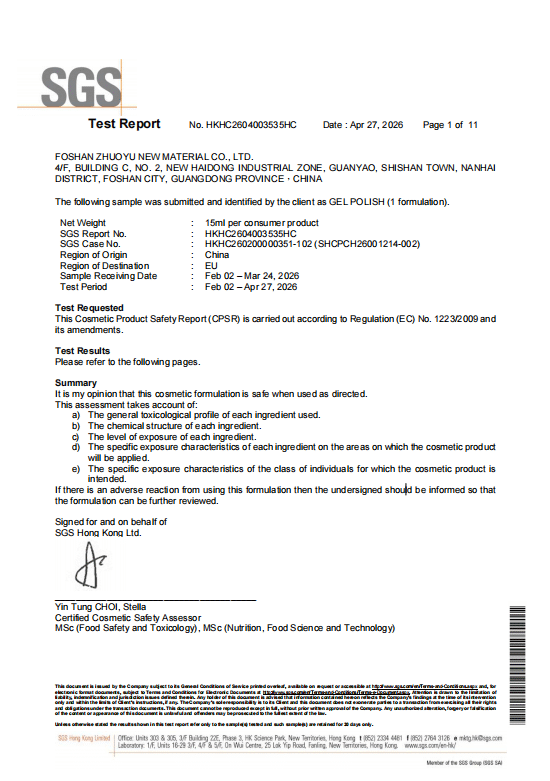
- CPSR reference and issue date for that exact formula, naming the responsible person it was issued for. A CPSR issued to another brand is not transferable without re-issue.
- Migration or leach testing where the product contacts skin for extended periods, plus a statement of the test method used.
- Change-control clause. Any formula, supplier or subcontractor change triggers re-issue of the declaration and CPSR update before shipment.
- Retained sample commitment. A sealed retention sample per batch, held for the period your PIF requires.
- Audit right. The right to inspect the production record for the batch, not just the certificate.
Put these in the quality annex, not the email thread. When a customs officer or a market-surveillance authority asks in eighteen months, the email thread is gone and the annex is not.
The documentation set that has to travel with the goods
For an EU-bound private label order, the minimum file set is: CPSR (Part A and Part B), the safety assessor’s qualification statement, the product information file index, CPNP notification number once the responsible person has filed, GMP or ISO 22716 evidence for the manufacturing site, and the batch-linked substance declaration above. SDS is a chemical-safety document for transport and workplace handling, not a cosmetic compliance document — it does not replace a CPSR, and buyers who accept an SDS in place of one usually discover the gap at the importer.
For a worked example of how the CPSR step behaves in a real private label project, see our CPSR and EU launch checklist for builder gel.
What to ask before you approve a sample
Send these five questions with the sample request. The quality of the answers tells you more about the supplier than the sample itself:
- Which photoinitiator system replaces TPO, and what is the recommended cure time for the darkest shade in the range?
- Can you send the CPSR for this formula, issued to my brand name, before I place the bulk order?
- Which entity will act as responsible person, and is the CPNP account already open?
- What is your change-control process if a raw material supplier discontinues an ingredient?
- Can you provide a retained sample from the pilot batch alongside the production batch?
You can review our HEMA-free and TPO-free gel polish range as a starting point, or see how a builder gel programme is set up for private label volumes.
Proving the claim, not just making it
“TPO-free” is a factual claim about composition, and in the EU it falls under the general obligation that claims must be verifiable. The evidence a reviewer will actually look for is narrower than suppliers assume:
- A quantitative formula with CAS numbers, showing the photoinitiator system and its concentration, not just the marketing term.
- Analytical confirmation where the risk is contamination rather than formulation. If the same production line runs TPO-containing batches for other customers, a declaration alone is thin; a line-clearance procedure and periodic analytical screening is the stronger answer. This is the practical reason dedicated lines cost more.
- Cure and adhesion data for the darkest shade in the range, because that is where an under-cured system shows up first, and an under-cured methacrylate system is a sensitisation risk, not only a durability problem.
- Stability data covering the claimed shelf life, since some substitute initiator packages age differently from TPO systems.
Ask for these four items and you will quickly separate a reformulated product from a reformulated label. Suppliers who have done the work usually have the file ready; suppliers who have relabelled a TPO-containing base typically answer the request for a line-clearance procedure with silence.
What to do with existing stock
Brands that imported TPO-containing stock before the cut-off have a decision to make, and it is a legal decision before it is a commercial one. Products placed on the EU market before 1 September 2025 can generally continue to be made available, which means existing distributor stock is not automatically unsellable. What is not permitted is placing new units on the market after that date, including units manufactured from remaining raw material. If you hold concentrate or semi-finished gel that was not yet placed on the market, it cannot be converted into new saleable product after the cut-off.
The documentation that protects you here is the placement date with evidence: invoices, shipping documents and batch records. A brand that cannot show when the goods entered the EU market is relying on the importer’s memory. Keep that file with the batch record, not in a spreadsheet on someone’s laptop.
Frequently asked
Is HEMA banned in the EU?
No. It is restricted to professional-use nail products, with mandatory warnings. “Banned” and “restricted to professional use” have different commercial consequences: the first removes a product from the market, the second changes who may buy it and what the label must say.
Can a TPO-containing product still be sold in the EU?
Only if it was placed on the EU market before 1 September 2025. New units cannot be placed after that date. If a supplier cannot tell you the placement date with documentation, treat the stock as non-compliant.
Does HEMA-free mean hypoallergenic?
No. HEMA-free removes one sensitiser from the formula; methacrylates as a class remain potential sensitisers, and the professional-use warning still applies to many systems. Hypoallergenic is a claim with its own evidentiary burden and should not be inferred from an ingredient absence.
Next step
If you are reformulating for 2026 ranges, the fastest path is to send your current formula’s INCI list and target market, and we will tell you which of the two regulatory hooks it fails, and what a compliant replacement costs at your volume. Request a formula review, or read the OEM and private label service scope first.