
EU Compliance · Cosmetics Regulation (EC) No. 1223/2009
CPSR for Builder Gel: the one document that decides how fast your European launch actually happens
Every brand owner and distributor selling UV/LED gel into the EU eventually hits the same bottleneck — not colour development, not packaging, not freight. It is the Cosmetic Product Safety Report. This article explains what a CPSR is, what ours contains, what it proves, and what your brand still has to do before your first pallet lands in Rotterdam.
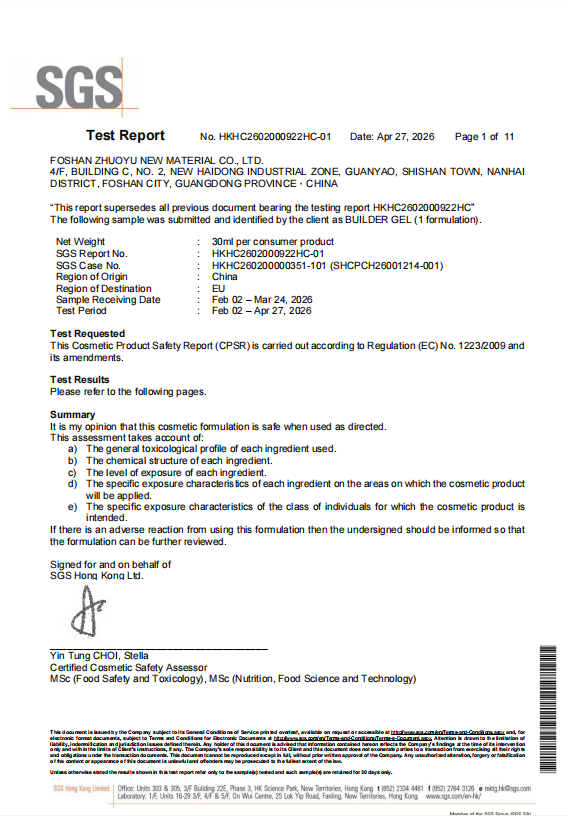
Foshan Zhuoyu New Material Co., Ltd. holds an 11-page Cosmetic Product Safety Report for its BUILDER GEL formulation, issued by SGS Hong Kong Ltd. on 27 April 2026 under report number HKHC26020000922HC-01. The assessment concludes the formulation is safe when used as directed and complies with Regulation (EC) No. 1223/2009 and its amendments.
Below is the substance of that report — the parts a wholesale buyer, private-label brand or EU importer needs in order to make a purchasing decision without a three-week email exchange.
1. What a CPSR is — and what it is not
Under Article 10 of Regulation (EC) No. 1223/2009, no cosmetic product may be placed on the EU market without a safety assessment carried out by a qualified safety assessor. That assessment, together with its supporting data, forms the Cosmetic Product Safety Report.
A compliant report has a fixed architecture, and ours follows it:
- Part A — Cosmetic product safety information: formula and concentrations, physical/chemical characteristics and stability, microbiological quality, impurities and traces, packaging material, normal and reasonably foreseeable use, exposure, toxicological profiles of each substance, undesirable effects, and manufacturing/GMP information.
- Part B — Cosmetic product safety assessment: the assessor’s conclusion, the recommended label warnings and instructions of use, and the reasoning behind the conclusion.
- Annex 1 — Toxicological profile of individual ingredients: substance-by-substance review with CAS numbers, CIR/SCCS positions, NOAEL, systemic exposure dose (SED) and margin of safety (MoS).
The report must be signed by the assessor. Ours is signed by Yin Tung CHOI, Stella, Certified Cosmetic Safety Assessor, MSc (Food Safety and Toxicology), MSc (Nutrition, Food Science and Technology).
2. The report at a glance
| Field | Detail |
|---|---|
| Product | BUILDER GEL (1 formulation) |
| Report number | HKHC26020000922HC-01 |
| Date of issue | 27 April 2026 |
| Issued by | SGS Hong Kong Ltd. |
| Regulation applied | Regulation (EC) No. 1223/2009 and its amendments |
| Region of destination | EU |
| Region of origin | China |
| Net weight assessed | 30 ml per consumer product |
| Sample receiving period | 02 Feb – 24 Mar 2026 |
| Assessment period | 02 Feb – 27 Apr 2026 |
| Document length | 11 pages (Part A, Part B, Annex 1) |
| Product type / use category | Makeup cosmetics / Builder Gel / liquid |
The assessor’s overall conclusion, in the report’s own terms:
“It is my opinion that this cosmetic formulation is safe when used as directed.”
“The product complies with the Regulation (EC) No. 1223/2009 and its subsequent amendments when used as directed.”
3. The five things a buyer’s compliance team actually checks
3.1 Formulation and toxicological profile
The assessed formulation contains eight declared components. Every one is reviewed individually in Annex 1 against the EU Cosmetics Regulation, SCCS opinions and CIR recommendations:
| INCI name | CAS No. | Concentration |
|---|---|---|
| Acrylates/Carbamate Copolymer | N/A | 79.5% |
| Acrylates Copolymer | 25035-69-2 | 10.0% |
| Trimethylbenzoyl Diphenylphosphine Oxide | 270586-78-2 | 5.0% |
| Dimethicone | 9006-65-9 | 2.0% |
| Microcrystalline Wax | 63231-60-7 | 2.0% |
| CI 14700 | 4548-53-2 | 0.5% |
| CI 77891 | 13463-67-7 | 0.5% |
| CI 77499 | 1309-37-1 | 0.5% |
Where a No Observed (Adverse) Effect Level or Point of Departure exists, the assessor derived a systemic exposure dose and a Margin of Safety. Three representative values from the annex:
| Substance | NOAEL | SED | Margin of Safety |
|---|---|---|---|
| Trimethylbenzoyl Diphenylphosphine Oxide | 300 mg/kg bw/day | 0.09125 mg/kg bw/day | 1643 |
| Dimethicone | 1500 mg/kg bw/day | 0.0365 mg/kg bw/day | 20547 |
| Microcrystalline Wax | 1100 mg/kg bw/day | 0.0365 mg/kg bw/day | 15068 |
For substances without an available NOAEL or POD, the report substantiates safety through history of safe use at similar levels, reference doses and the TTC approach rather than leaving a gap.
3.2 Stability
In-house stability testing was submitted and reviewed: 12 weeks at −15 ± 2 °C, 25 ± 2 °C and 45 ± 2 °C (testing period 08 Oct 2025 – 31 Jan 2026), assessed on appearance and odour. Conclusion: the stability of the formulation is acceptable for this application. That temperature spread matters — it covers cold-chain winters in northern Europe and unventilated summer warehouses in the south.
3.3 Microbiological quality
Third-party testing to European Pharmacopoeia 11.0, sections 2.6.12 and 2.6.13 (SGS report SHCPCH26001256-02_EN, 02–10 Feb 2026). The product is classified as Category 2 — other products, limit ≤ 1000 cfu/g or 1000 cfu/ml, with E. coli, P. aeruginosa, S. aureus and C. albicans not detectable in 1 g or 1 ml. Conclusion: microbiological quality is acceptable. Because the product is a low microbiological risk product, a preservation efficacy test was not required.
3.4 Impurities, traces and packaging
Heavy metals in the formulation (SGS report SHCPCH26001256-02_EN, 02–10 Feb 2026) were reviewed against German BGA criteria — As ≤ 5, Hg ≤ 1, Pb ≤ 20, Sb ≤ 10, Cd ≤ 5, Ni ≤ 10 mg/kg. Conclusion: acceptable for this application.
Packaging is PP box, PP cap and PP gasket. Total lead, cadmium, mercury and chromium VI across those components were tested (SGS report SHCPCH26001256-03_EN, 02–06 Feb 2026) and confirmed at less than 100 ppm. Packaging compatibility with the gel was additionally tested over the same 12-week, three-temperature regime, on appearance and packaging appearance: acceptable.
3.5 Manufacturing and GMP
The product is manufactured at Foshan Zhuoyu New Material Co., Ltd. in a setting certified to ISO 22716:2007 — scope: manufacturing of Organic Solvents Unit, including Nail Polish Gel — under Intertek certificate SZ2406B4, valid until 11 June 2027. A GMP certificate with a visible expiry date is worth more to your auditor than a logo on a brochure.
4. On prohibited substances: what the report can and cannot claim
This is where suppliers tend to overreach, so we will state exactly what the document supports.
The report confirms:
- No CMR substance is indicated as intentionally added to the formulation.
- All ingredients are reported for cosmetic use, or within the recommended limit set by SCCS and the Cosmetic Ingredient Review.
- There are no nanoparticles indicated in the formulation.
- No perfume is present, therefore no fragrance allergens require declaration.
- The finished product declaration states it contains no polymerisation inhibitors — neither hydroquinone nor p-hydroxyanisole (BHA), the stabiliser chemistry most often used to stop premature polymerisation in acrylate systems. For gel buyers this is the detail experienced formulators ask about first.
- Dimethicone was tested for cyclic siloxanes (SGS report CANEC25003417001, 25 Feb – 03 Mar 2025): D4 not detected (method detection limit 0.05%), D5 at 0.115%, D6 at 0.112%.
- The three colourants are permitted colorants under the EU Cosmetics Regulation and must meet the purity criteria of the relevant Commission Directives.
The report does not say — and we will not claim — that the product is “chemical-free”, “100% natural” or allergen-free. No UV-cured gel is. What it says is narrower and far more useful: the assessed formula uses permitted ingredients at permitted levels, contains no intentionally added CMR substance, and carries a quantified safety margin.
One further point the report raises deliberately: because the formula contains skin sensitisers, labelling is part of the safety conclusion, not an optional extra. See the next section.
5. The part most suppliers never show you: the required warnings
Your EU label depends on this paragraph. The report’s Part B lists the warnings and instructions of use that must accompany the product. A wholesaler who ships without them is shipping a non-compliant product, regardless of how good the CPSR is.
Recommended label warnings and instructions of use (from Part B of the report): Use as directed. Keep out of reach of children. May cause sensitization by skin contact. Avoid contact with eyes, mouth and skin. Rinse them immediately should the product come into contact with them. If there is any incident, contact the poison centre immediately. Stop using the product if redness and itching develop. If symptoms persist, consult a doctor.
We publish this openly because it is in the file you will receive anyway, because your Responsible Person must reproduce it on pack and in the instructions for use, and because discovering it after your artwork is printed is an expensive way to learn it.
The exposure model behind the assessment is worth knowing when you plan your marketing: application to nail plates, 22 cm² surface area, 4 g per application, 3360 minutes of exposure, 20 applications per year, 60 kg body weight, estimated 219 mg/day. The assessor also notes that because the gel is cured under UV/LED within minutes, dermal and inhalation exposure to individual ingredients is limited — which is why the margins of safety above are as wide as they are.
6. What your brand still has to do before launch
The CPSR is the heaviest item in the file. It is not the whole file. A realistic EU pre-launch checklist for a wholesale or private-label brand:
| # | Obligation | Legal basis | Who does it |
|---|---|---|---|
| 1 | Appoint a Responsible Person established in the EU/EEA | Art. 4 | Your brand (or your EU distributor) |
| 2 | Assemble the Product Information File, with the CPSR as its core | Art. 11 | Your brand, held by the RP |
| 3 | Notify the product in CPNP before placing it on the market | Art. 13 | Your brand / RP |
| 4 | Label to Article 19: RP name and address, batch code, nominal content, warnings, INCI list, date of minimum durability or PAO | Art. 19 | Your brand, artwork reviewed against the CPSR |
| 5 | Keep the file available to competent authorities for 10 years after the last batch is placed on the market | Art. 11(3) | Your brand |
Items 1 to 5 typically take two to five working days once the RP is appointed and the artwork is final — because the safety assessment, the part that normally takes weeks and four figures in consultant fees, is already done and in your hands.
7. How to verify what we send you
Any supplier can email a PDF. Before you accept one, check:
- The report number is stated consistently on every page — ours is HKHC26020000922HC-01, dated 27 April 2026, 11 pages.
- The assessed product name and pack size match the goods you will receive — ours is BUILDER GEL, 30 ml, EU destination.
- Part B carries a signature and the assessor’s qualifications, not just a company stamp.
- The supporting laboratory reports are referenced inside the CPSR by their own report numbers — we list three SGS sub-reports plus the Intertek GMP certificate.
- The stability and microbiology work has actual test dates, not just “compliant”.
- The warnings section exists. A CPSR with no label warnings for a sensitiser-containing gel is an incomplete CPSR.
8. Document access: page one in public, the rest under NDA
The image at the top of this page is page 1 of the original report, reproduced unaltered. Pages 2 to 11 are not published: they disclose the full quantitative formula, exposure calculations and ingredient-level toxicology, which is both commercially sensitive and the technical core of our customers’ competitive position.
Qualified wholesale partners receive, at sample or quotation stage and under a simple NDA:
- The complete 11-page CPSR, including Part A, Part B and Annex 1
- The three referenced SGS laboratory reports (microbiology, heavy metals in formulation, heavy metals in packaging)
- The Intertek ISO 22716:2007 GMP certificate (SZ2406B4, valid to 11 June 2027)
- Written confirmation of the label warnings for your market and language
If your compliance team needs a specific data point before that stage — a CAS number, an MoS value, a heavy-metal limit — ask. We will quote it from the report rather than paraphrase it.
9. Frequently asked questions
Is a CPSR the same as a certificate?
No. It is a safety assessment produced by a qualified assessor and signed by them. It becomes part of the Product Information File. Treat any supplier describing a CPSR as a “certificate” as a signal to read their documents more carefully.
Can I sell this gel under my own brand using your CPSR?
Yes, in the normal case: unchanged formula, the pack sizes and packaging materials assessed, and the intended use as described. Your Responsible Person files it within your PIF and notifies the product in CPNP. If you alter the formula, the packaging material or the intended use, a new or updated assessment is required.
Does the report cover other pack sizes?
The assessment is based on a 30 ml consumer unit. If your line needs 15 ml, 50 ml or a different closure, tell us and we will confirm coverage against the existing file rather than leaving you to assume it.
Is the formula HEMA-free?
The assessed formula contains no HEMA or Di-HEMA — the eight declared components are listed in section 3.1. The report itself does not state “HEMA-free” as a claim, so if your market requires that wording on pack, ask us for a separate written declaration.
Does this cover the UK as well?
No. Great Britain operates its own regime — a UK Responsible Person and SCPN notification are required separately. The EU assessment is a strong starting point for that file but is not a substitute for it.
How current is the report?
Issued 27 April 2026, following a sample receiving period of 02 February to 24 March 2026 and an assessment period ending 27 April 2026. We will tell you in writing if a reformulation or new safety information requires it to be updated.
Request the full CPSR pack
Tell us your target market, pack size and expected volume. We will send the complete 11-page report, the three supporting SGS laboratory reports and the GMP certificate under NDA, usually within one working day.
This article is provided as business and technical information for professional buyers. It summarises a specific safety assessment for one formulation and is not legal advice; obligations under Regulation (EC) No. 1223/2009 rest with the Responsible Person placing the product on the market. Report data quoted above is taken from SGS report HKHC26020000922HC-01 dated 27 April 2026, the corresponding SGS laboratory sub-reports, and Intertek certificate SZ2406B4.
