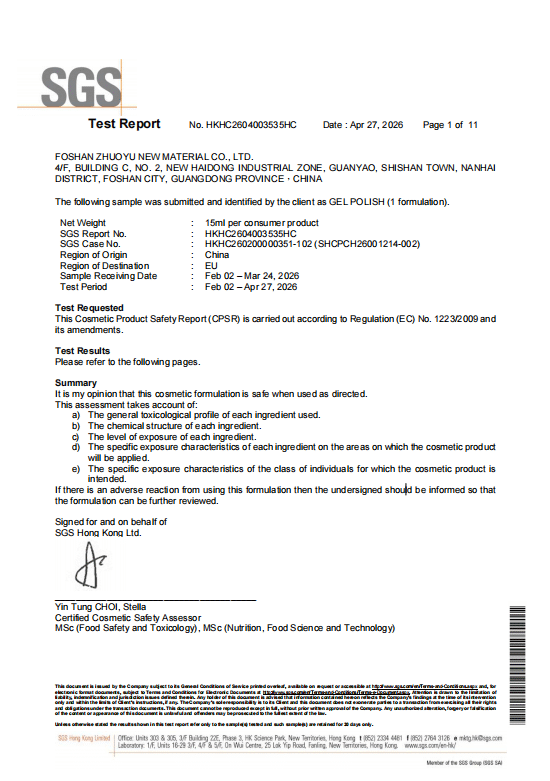
The CPSR is the gate, not the paperwork
Almost every private label gel polish project we run hits the same bottleneck at the same place: the brand has a formula, a colour range, packaging mock-ups and a launch date, and then discovers that none of it can be placed on the EU market until a Cosmetic Product Safety Report exists for that exact formula — signed by a qualified safety assessor, naming the responsible person who will hold the file.
This article is written from the factory side of that handover. It covers what a CPSR contains, who is allowed to sign it, how long it realistically takes, what the brand must supply before the clock starts, and the five mistakes that cause most re-issues.
What a CPSR actually contains
The CPSR is defined in Annex I of Regulation (EC) No 1223/2009. It has two parts, and conflating them is the first source of delay.
| Part | Content | Who produces it |
|---|---|---|
| Part A — Cosmetic product safety information | Quantitative formula, physico-chemical properties, stability data, microbiological quality, packaging material safety, normal and reasonably foreseeable use, exposure assessment, toxicological profiles of each substance, undesirable effects, and the product’s regulatory status | Typically assembled by the manufacturer or a consultant, using the brand’s formula, packaging supplier data and test reports |
| Part B — Cosmetic product safety assessment | The assessor’s conclusion: the product is or is not safe for the intended use, with reasoning, labelling warnings and any use restrictions | Signed and dated by a qualified safety assessor only |
A supplier invoice labelled “CPSR” that runs to four pages and has no exposure calculation is Part B only, or worse, a template. Ask for the section list before you accept it.
Who is allowed to sign
The assessor must hold a diploma, certificate or other evidence of formal qualification in pharmacy, toxicology, medicine, a related discipline, or an equivalent qualification recognised by a member state, per Article 10(2). In practice most EU nail-cosmetic CPSRs are signed by pharmacists or toxicologists working for an authorised safety assessment body.
The practical test for a brand owner is not the assessor’s CV, it is the chain of accountability: the CPSR must be issued for your product, under your responsible person. A report issued to the factory’s own brand cannot simply be re-badged, because the exposure scenario, the packaging and the claims differ. Re-issue, not photocopy, is the correct move — and it is normal for a supplier to charge for it.
How long it really takes
Assessors quote in working days from the moment they hold a complete dossier, not from the moment you ask. Realistic planning figures for a gel polish range:
- Dossier assembly at the factory: 3–10 working days, assuming the formula is frozen and the pack is chosen.
- Assessor review and signature: 5–15 working days for a straightforward range; longer if a substance needs an additional toxicological justification.
- Re-issue after a formula or packaging change: back to the start of the assessor queue, though usually with a shorter review.
Two things routinely destroy that schedule. The first is a colour range treated as one product when the shades have materially different pigment loads — the assessor will ask whether the exposure and stability data cover every variant. The second is packaging that arrives after the formula, because the migration assessment cannot be closed without the actual container and applicator materials.
What the brand must supply before the clock starts
This is the checklist we send at project kick-off. If any line is missing, the timeline above does not apply.
- Brand name, product name and the full variant list with shade codes.
- Intended use and user type — professional only, or consumer. This single decision changes the HEMA position and the labelling.
- Target markets. EU member states first; note any additional national requirements.
- Claims you intend to publish: “HEMA-free”, “TPO-free”, “10-free”, “vegan”, “cruelty-free”, “long-wear”. Each claim must be substantiated in the file.
- Packaging specification: bottle, cap, brush, liner materials, and decoration method.
- Label artwork with the responsible person’s EU address, batch code position, PAO or minimum durability, and warnings.
- Existing test data, if any, and the identity of the responsible person who will hold the Product Information File.
The Product Information File itself must be kept for ten years after the last batch is placed on the market, and must be accessible to the competent authority in the language of the member state where it is held (Article 11). That is an operational commitment, not a document.
Where CPSR sits relative to CPNP
These are sequential, not parallel. The responsible person files the CPNP notification before placing the product on the market, and the notification depends on the CPSR existing, because the notification includes the category, the responsible person, the presence of CMR substances and the frame formulation data. A brand that books a launch date before a signed CPSR exists is booking a date it does not control.
The notification flow, the responsible person’s obligations and a launch checklist are covered separately in our CPSR and EU launch checklist for builder gel.
Five mistakes that cause re-issues
- Freezing the formula after the CPSR. The most common cause. Any change to a raw material, a supplier of a raw material, or a pigment lot specification requires an update, because the toxicological profile and the impurity profile may change.
- Treating a colour range as one line. Shades with materially different pigment systems need explicit coverage in Part A.
- Changing packaging without telling the assessor. Migration assessment is pack-specific.
- Publishing claims the file does not support. “Non-toxic” and “safe for sensitive skin” are the usual offenders.
- Naming a responsible person who has not agreed in writing. The RP carries legal liability; a supplier cannot assign that role on a brand’s behalf by email.
What this means for your order
If you are ordering from a Chinese factory and selling into the EU, decide the compliance route before the formula: who is the responsible person, which markets, professional or consumer, and which claims. Those four answers determine the formula options you can even be quoted. For the ingredient side of the same question, read our note on HEMA and TPO changes in 2025.
We can supply the formula data, stability and microbiological testing, packaging information and the manufacturer’s section of Part A, and work directly with your assessor or with one we introduce. Send your variant list and target markets and we will return a documentation timeline before commercial terms.
What you are actually paying for
Brand owners often compare CPSR quotes as if the document were a commodity. The variance is not in the signature, it is in what precedes it. Three cost drivers explain almost all of the spread between a lean quote and an expensive one:
- Whether the toxicological profiles already exist. An assessor who has assessed the same methacrylate monomers and pigments before can reuse the reasoning; a novel pigment or a nano-form filler requires new justification and possibly new literature review.
- How many variants the report must cover. A range report with a variant annex is cheaper per shade than separate reports, but only if the shades genuinely share a pigment and exposure profile.
- Whether testing has to be commissioned. Stability, microbiological challenge testing and pack migration testing are separate line items. A quote that excludes them is not cheaper, it is smaller.
The useful question is therefore not “what does a CPSR cost” but “which inputs do I already own”. A brand that arrives with frozen formula, final pack, defined claims and existing stability data typically pays for assessment. A brand that arrives with a formula spreadsheet pays for assessment plus everything upstream of it.
The five-year view of the same document
A CPSR is not a one-off deliverable, it is a maintained record. Over a typical five-year product life you should expect at least three triggers for an update: a raw material discontinuation that forces a supplier change, a packaging change when a bottle supplier modifies a liner, and a regulatory amendment such as the 2025 CMR update. Each trigger has a cost and a lead time, and neither is in the launch budget of most first-time brands.
The mitigation is contractual rather than technical: a change-control clause that requires the factory to notify you before substituting a raw material, and a formula lock that makes any deviation a written variation rather than a production decision. Suppliers who resist that clause are telling you something about how much formula drift you should expect.
Frequently asked
Can I use the factory’s CPSR for my own brand?
Not as a copy. The CPSR must be issued for your product and your responsible person. A factory can hold a base report for the formula, but the report in your file must name your product, your packaging and your claims.
Does every shade need its own CPSR?
Not necessarily a separate document, but every variant must be covered by the assessment. Assessors usually accept a range report with a variant annex, provided the pigment systems and exposure are addressed.
Is an SDS a substitute for a CPSR?
No. The SDS addresses chemical hazards for transport, storage and workplace handling. The CPSR addresses consumer and professional safety of the cosmetic product. They answer different questions for different readers.