
ZHUOYU regulatory notes
HEMA and TPO free gel polish excludes two different ingredients under two different legal rules. One is restricted in the EU. The other is prohibited. Treating them as one sourcing problem is how a compliant sample turns into a non-compliant shipment.
The rules arrived five years apart, sit in different annexes and serve different purposes. If you are building a range for the EU or Great Britain, know which rule bites where — and what to ask your supplier for.
HEMA and TPO do different jobs in the bottle
HEMA is a small monomer. It wets the nail plate well and helps the cured film grip. Formulators used it because it improved adhesion at low cost.
TPO is a photoinitiator. It absorbs lamp energy and starts the curing reaction. Without a photoinitiator, the gel stays liquid under the lamp.
So one helps build the film; the other switches the reaction on. Remove either and the product behaves differently. Reformulation therefore takes laboratory work, not a label edit.
| Point | HEMA | TPO |
|---|---|---|
| Function | Monomer; adhesion | Photoinitiator; curing |
| EU status | Restricted | Prohibited |
| Legal instrument | Regulation (EU) 2020/1682 | Regulation (EU) 2025/877 |
| Where it sits | Annex III, entries 313 and 314 | Annex II, entry 1731 |
| Date that matters | 3 June 2021 | 1 September 2025 |
| Consumer sale in EU | Not permitted under the restriction | Not permitted |
| Professional use in EU | Permitted with mandatory warnings | Not permitted |
TPO is prohibited in the EU, with no separate sell-through clause
Commission Regulation (EU) 2025/877 added Trimethylbenzoyl Diphenylphosphine Oxide to Annex II of the EU Cosmetics Regulation — the prohibited list — as entry 1731. It deleted the previous professional-use entry from Annex III. The regulation applies from 1 September 2025.
The legal trigger was a chemicals-classification change, not a new nail-specific study inside the cosmetics measure. Delegated Regulation (EU) 2024/197 lists TPO as Repr. 1B with H360Fd, and its harmonised classification also applies from 1 September 2025. Under Article 15 of the Cosmetics Regulation, a CMR 1A/1B/2 substance is prohibited unless a specific exception is granted. No exception was requested for TPO.
Planning point: the TPO regulation sets one application date and contains no separate transition or sell-through provision. Treat an EU-bound order as needing to be TPO-compliant before it ships, not before it reaches the shelf.
The Cosmetic, Toiletry and Perfumery Association (CTPA) says the ban reflects a worst-case hazard assessment and does not mean that existing TPO nail products are unsafe. Keep that distinction in your copy. Describe the legal status accurately; do not imply that regulators published findings of harm to gel wearers.
Great Britain runs a different clock
GB did not copy the EU date. Under the timetable reported by CTPA, TPO products could no longer be placed on the GB market from 15 August 2026. Existing stock may remain available until the off-shelf date of 14 February 2027. As of 21 November 2026, the first date has passed and the second is close.
| Market | Cannot be placed on market | Off-shelf / cannot be made available |
|---|---|---|
| European Union | 1 September 2025 | 1 September 2025 |
| Great Britain | 15 August 2026 | 14 February 2027 |
That split forced two specifications for more than a year. After February 2027 it closes. Anything you ship now for GB sale should already be TPO free: the remaining sell-through window is shorter than a normal reorder cycle.
HEMA is restricted, not banned
Commission Regulation (EU) 2020/1682 added HEMA to Annex III, the restricted list. It did not ban the ingredient. Annex III permits use under stated conditions, and this restriction is limited to nail products for professional use only.
The entries are 313 for HEMA and 314 for Di-HEMA Trimethylhexyl Dicarbamate. Both carry the same field of use, the same condition and the same two mandatory label warnings:
- “For professional use only”
- “Can cause an allergic reaction”
The dates ran in two steps. From 3 June 2021, non-compliant products could not be placed on the Union market. From 3 September 2021, they could not be made available on it.
A HEMA-containing gel sold to a trained nail technician can therefore be lawful when the warnings are on pack. Sold to a consumer for home use, it is not. The EU measure explains the professional-only limit by the higher skill expected of professionals and the risk of application to skin next to the nail plate.
Di-HEMA is not a loophole. Removing HEMA while leaving Di-HEMA Trimethylhexyl Dicarbamate in the formula does not create a genuinely HEMA-free range. It has its own Annex III entry, the same professional-use restriction and the same warning requirements.
What this decides about your range
Start with the channel. A consumer-facing EU range cannot contain HEMA under the current restriction. A professional range can, provided the pack carries the required warnings. That is a commercial decision before it is a formulation decision.
Next, decide which markets ship from the same batch. EU and GB stock may come off one production run. If it does, the EU rule sets the specification for both, because TPO free is mandatory for anything EU-bound. Running separate formulas doubles artwork, documentation and batch tracking — and increases the chance of the wrong carton reaching the wrong market.
Many brand owners now specify HEMA and TPO free across the whole range. That is an operational decision rather than a legal requirement. Test adhesion and cure performance before committing: a HEMA-free formula may not match the grip of the original system. Our note on HEMA and TPO reformulation covers that trade-off in more detail.

What a “free from” claim actually proves
A HEMA and TPO free claim describes what a formula excludes. It is not a safety claim. It does not mean hypoallergenic, and it does not mean the product is cleared for sale. Other acrylates can still sensitise, so the wording should stay narrow.
The claim is also specific to a formula and SKU. A factory may run a HEMA-free product on one line and a HEMA-containing professional range on another. Ask exactly which formula the claim covers — and whether it holds batch to batch, not just for the sample you tested.
- The full INCI list for the exact formula you are buying
- The SDS for that formula
- Test reports naming the formula they cover
- Written confirmation that the claim applies batch to batch


Put it in the specification, not the email thread
Verbal assurances do not survive a factory or staff change. Put the requirement at order level, using INCI names rather than marketing shorthand.
All units supplied under this order shall be free from 2-Hydroxyethyl Methacrylate (HEMA), Di-HEMA Trimethylhexyl Dicarbamate, and Trimethylbenzoyl Diphenylphosphine Oxide (TPO). The supplier shall provide the full INCI list, SDS, and supporting test reports naming the formula supplied, for each production batch.
Three details do real work here. INCI names match test reports and labels. Naming Di-HEMA separately closes the common narrow reading of “HEMA free”. Tying documents to each production batch turns a one-off sample report into an ongoing obligation. Add the full market list to the same document so the supplier can flag market-specific problems early.
Where ZHUOYU fits
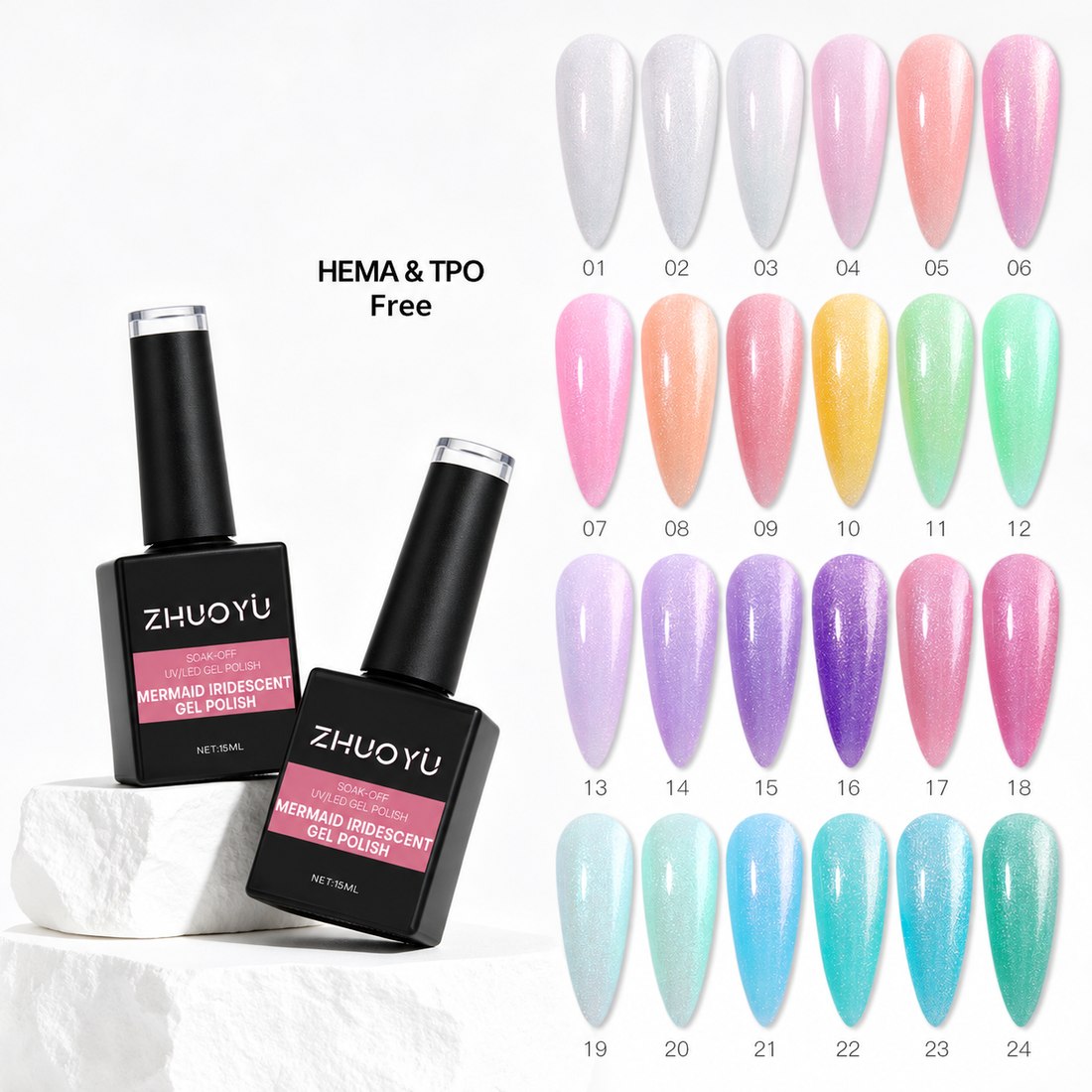
ZHUOYU manufactures HEMA and TPO free gel polish for brand owners, including buyers serving the EU and UK. The current HEMA/TPO-free range includes gel polish, builder gel and effect products. Ask for the CPSR file and test reports for any formula you are considering; SDS and INCI data support your technical file.
Production runs under ISO 22716 and GMP manufacturing at the Foshan site. ZHUOYU’s published factory profile gives a 3,100 m² facility, three production lines and 28 machines, with full-line quality checks and batch traceability.
Colour matching and custom texture development are available where stock shades do not fit the brief.

One boundary should be clear. CPNP is a notification system, not a certificate. ZHUOYU can provide documentation and notification support, but your designated EU Responsible Person submits the notification and carries the legal responsibility. Our Responsible Person guide explains that division of roles.
Sources checked
- Commission Regulation (EU) 2025/877 — TPO moved to Annex II; applies 1 September 2025.
- Commission Delegated Regulation (EU) 2024/197 — TPO classified Repr. 1B; harmonised classification applies 1 September 2025.
- Commission Regulation (EU) 2020/1682 — HEMA and Di-HEMA entered Annex III; application dates and warning wording.
- CTPA, Ban of TPO in the EU and GB — EU and GB dates and the association’s safety-assessment position; published 6 March 2026, updated 13 August 2026.
- ZHUOYU company profile and HEMA/TPO-free category — manufacturer and range details.
Frequently asked questions
Is HEMA banned in the EU?
No. HEMA is restricted under Regulation (EU) 2020/1682 and listed in Annex III entry 313. Nail products containing it are for professional use only and must carry two warnings: “For professional use only” and “Can cause an allergic reaction”.
Is TPO banned in the EU?
Yes. Commission Regulation (EU) 2025/877 moved TPO to Annex II, entry 1731. The prohibition applies from 1 September 2025. The regulation contains no separate sell-through clause.
Is HEMA free the same as TPO free?
No. They are separate claims about separate ingredients. A gel can be HEMA free and still contain TPO, which makes it non-compliant for the EU. Ask for both confirmations in writing, with INCI names.
When did the TPO ban apply in Great Britain?
According to CTPA, TPO products could not be placed on the GB market from 15 August 2026, with an off-shelf date of 14 February 2027.
Does HEMA free mean hypoallergenic?
No. It describes an excluded ingredient, not a safety outcome. Other acrylates in a gel can still cause sensitisation. Treat it as a formulation statement.
What replaced TPO in gel formulas?
Formulators use other photoinitiator systems that cure under similar lamp wavelengths. The exact system affects cure depth and speed, so ask the supplier which system a formula uses and request cure data.
Does Di-HEMA count as HEMA?
It is a separate ingredient with its own Annex III entry, number 314, and the same professional-use restriction and warning wording. A formula containing it is not usefully described as HEMA free.
Can a supplier handle CPNP notification for me?
A supplier can provide documentation and support. The notification belongs to your designated EU Responsible Person, who carries the legal responsibility.
Do I need separate stock for the EU and GB?
Not if you specify one HEMA and TPO free formula for both markets. The EU rule is the stricter one, so a formula built to it also meets the incoming GB baseline.
Specify the formula once, and specify it properly
Send ZHUOYU the shades, finishes and bottle format you need. Ask for the CPSR file and test reports on any formula you are considering, then request samples before committing to a run. Contact the export team through the enquiry form.
